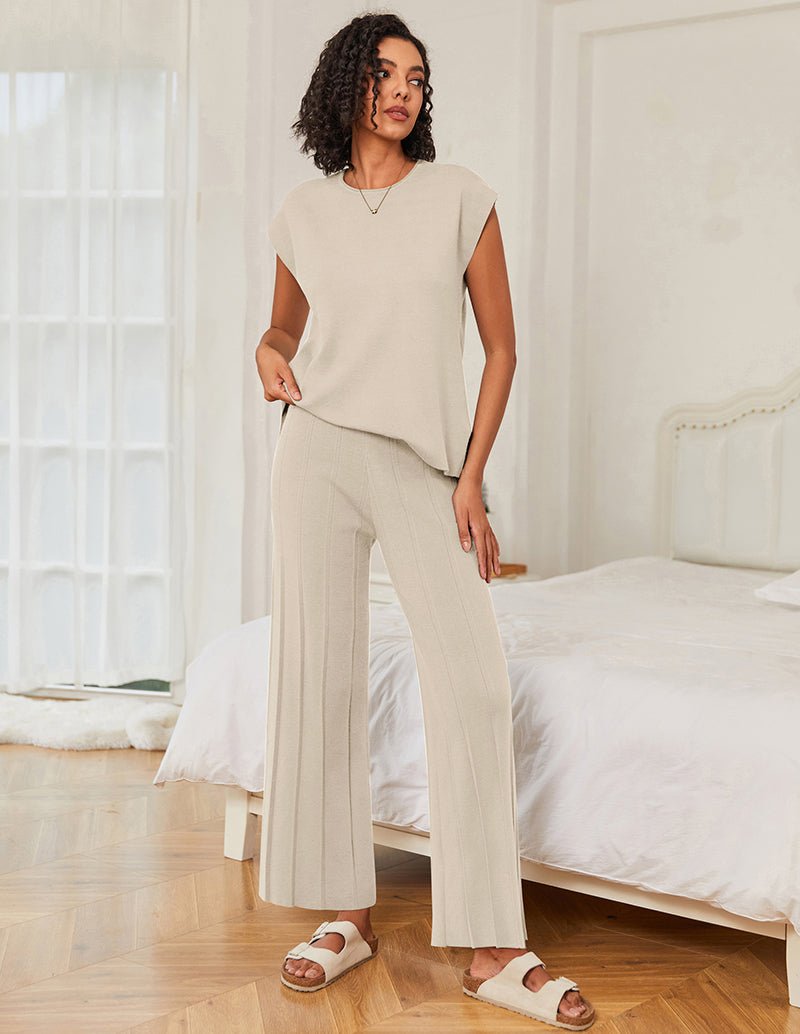
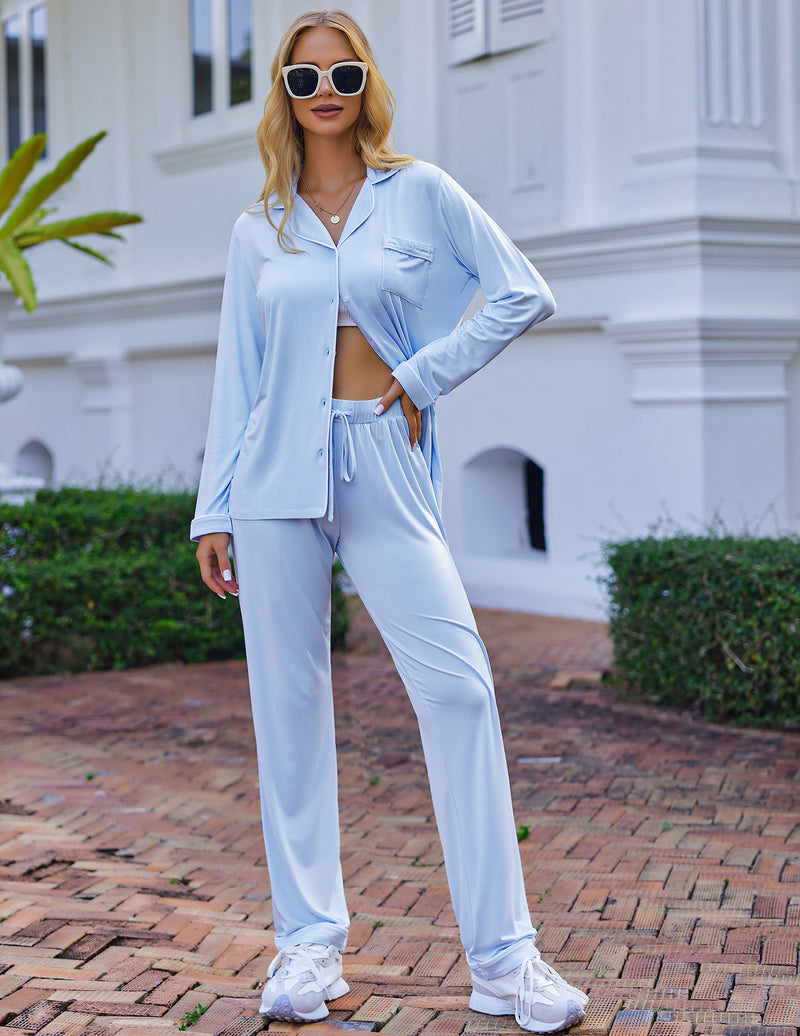
Satin Pajama Sets for Women: How to Choose, What to Expect, and How to Make Them Last

The direct answer first: a well-chosen satin pajama set is one of the best-value purchases in women's sleepwear — smooth against skin, cool on contact, wrinkle-resistant, and easy to care for. The catch is that "satin" is a weave construction, not a fiber, which means two sets with identical packaging can feel completely different and last dramatically different lengths of time.
This guide covers what actually distinguishes a good satin set from a poor one, which style works for which use case, and exactly how to keep them looking new.
What "Satin" Actually Means (And Why It Matters Before You Buy)
Most people treat "satin" as a fabric name. It isn't — it's a weave structure. The satin weave creates the characteristic smooth, shiny surface by floating warp threads over multiple weft threads before interlacing, which produces a glossy face side and a matte back.
The fiber underneath that weave can be:
-
Polyester — the most common by far; smooth, durable, machine-washable, not breathable
-
Silk — the premium tier; breathable, temperature-regulating, requires hand washing
-
Nylon — similar to polyester, sometimes used in lingerie-adjacent satin
-
Cotton — "cotton satin" (also called sateen) exists but behaves differently; less shiny, more breathable, more prone to shrinkage
Why this matters for buying: A $30 polyester satin set and a $200 silk satin set both legitimately say "satin." The feel at first touch is similar. The performance, longevity, and care requirements are fundamentally different. For most everyday use, polyester satin is the practical choice — it holds its appearance through repeated washing, doesn't require special care, and costs a fraction of silk. For a detailed breakdown of exactly where these two diverge, the satin vs. silk pajamas guide covers the performance differences in full.

What Polyester Satin Does Well (And What It Doesn't)
Understanding the honest performance profile prevents disappointment.
What it does well:
-
Cool-on-contact feel: The smooth surface reduces friction against skin, creating an immediate cool sensation. This is the primary reason people love satin pajamas — particularly for the first moments of getting into bed.
-
Visual appearance: The sheen looks polished and intentional. A satin set looks significantly more elevated than cotton, making it work for occasions where appearance matters — bridal getting-ready mornings, hotel stays, and being photographed.
-
Wrinkle resistance: Polyester satin bounces back from packing and storage better than cotton or linen. A cotton set folded in a drawer for a week will crease; a satin set in the same drawer typically doesn't.
-
Durability with proper care: Polyester satin shrinks less than 1% even with repeated washing, according to fabric care research. The fibers are structurally stable in a way that natural fibers aren't.
What it doesn't do as well:
-
Breathability: Polyester doesn't absorb moisture or allow airflow the way cotton does. In a warm room without air conditioning, a satin set can feel clammy rather than cool after the initial contact effect wears off.
-
Temperature regulation: Unlike silk, polyester satin doesn't adjust to body temperature. It stays cool on contact but eventually equilibrates to skin temperature and stays there.
The practical implication: Satin pajama sets work best in a temperature-controlled room (air conditioning in summer, heating in winter). In rooms above 72°F without climate control, cotton or bamboo outperforms satin for genuine comfort over a full night.
Real users notice this balance clearly. One woman shared: “The cool on contact is amazing but after a few hours they definitely get warm and a bit sticky if you run hot.” Another added: “Satin pajamas are my favorite for the look and initial feel, but I only wear them in AC because otherwise I wake up sweaty.”
The Three Satin Set Styles — and Which One to Choose
Cami Top + Shorts
The most versatile format and the most popular for good reason. The cami strap construction maximizes the satin's smooth feel against the skin without adding bulk at the shoulders. The shorts keep the lower-body coverage minimal, which helps with heat in warmer conditions.
Best for: Spring and summer, air-conditioned rooms, anyone who wants a polished look without the weight of pants. The cami-and-shorts format also photographs best — the shoulder and neckline are clean, and the set reads as intentional rather than utilitarian.

The satin solid cami top and shorts set covers this construction — the solid colorway keeps it versatile across seasons, and the cami format means you can wear the top alone in summer without it reading as sleepwear.
Short Sleeve Top + Pants (Classic Set)
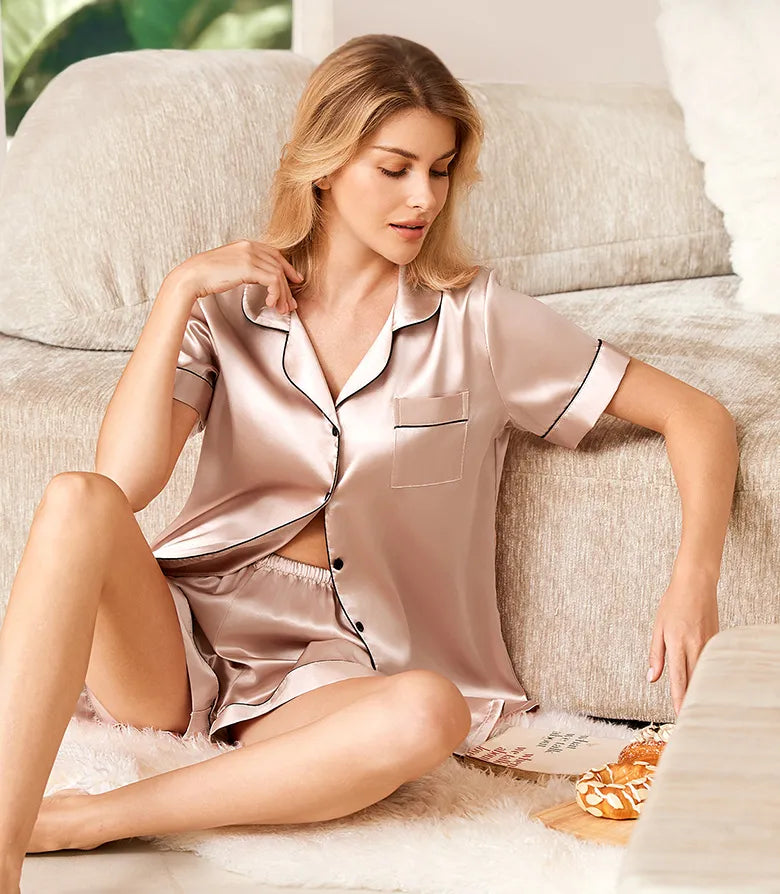
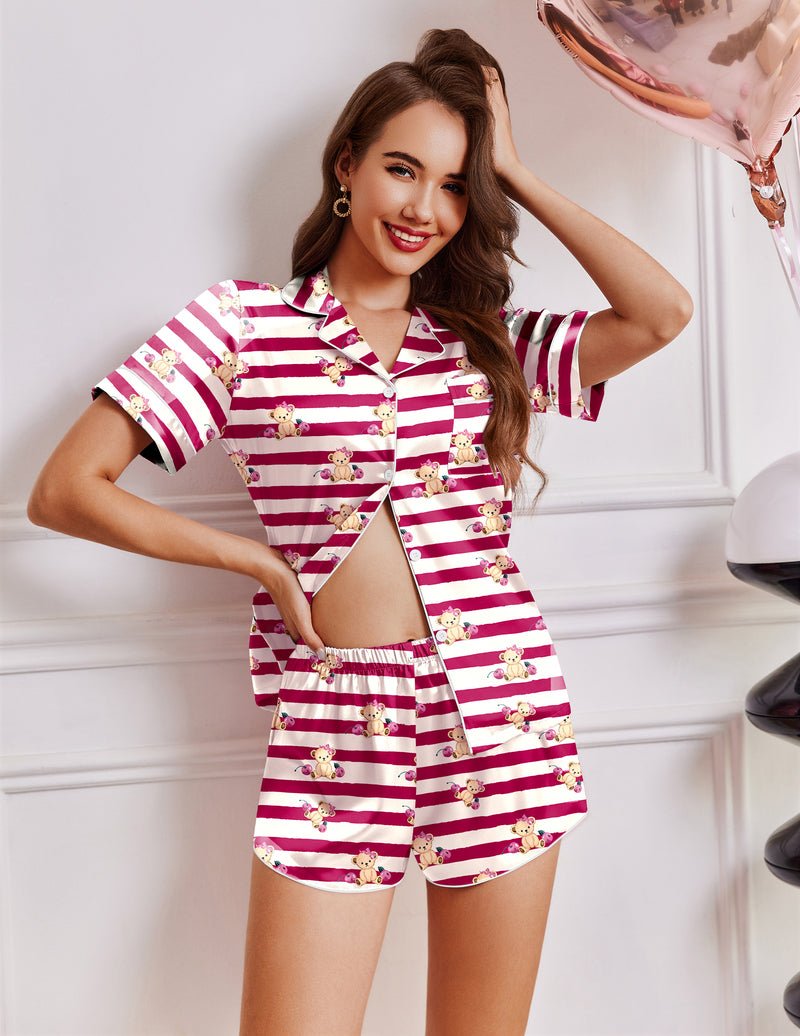
The most common format across the satin pajama category. The notch collar and button-front construction of most classic sets is the detail that gives them their characteristic polished appearance — it's the structural element that makes a satin set look intentional rather than just silky underwear.
The contrast piping detail: Many quality satin sets add contrast piping along the collar, cuffs, and pocket edges. This is worth paying attention to as a quality indicator — piping requires additional construction work, and brands that invest in piping tend to invest in fabric weight and seam finishing as well.
Best for: Year-round use, women who run cool or sleep in a cooler room, bridal and occasion wear, and anyone who wants the most polished appearance in a satin set.

The classic satin pajamas set uses this button-front construction — the classic format that works from the bedroom to a hotel morning without looking purely like sleepwear.
Long Sleeve Top + Full-Length Pants
Maximum coverage in satin. The long sleeve format adds warmth while maintaining the satin's smooth texture throughout. This is the format that works in autumn and winter — satin's thermal properties are neutral enough that a long sleeve set in a 68°F room is comfortable, where a short-sleeve set would feel cool.
The consideration: Long sleeve satin sets require slightly more careful care because the larger fabric surface area has more opportunities for snags. The sleeves specifically are vulnerable to catching on rough surfaces (jewelry, zippers, towel texture). Wash inside-out in a mesh bag.
The Ekouaer classic satin pajama set offers the long-sleeve construction with the button-front collar detail — the version that makes most sense as a gift or for occasions where a short-sleeve set feels too casual.
What to Actually Check Before Buying
-
GSM (Fabric Weight)
Most satin pajama listings don't advertise GSM, but it matters. Lightweight satin (under 60 GSM) is sheer, drapes nicely, but shows through, and feels insubstantial. Mid-weight satin (70–90 GSM) provides opacity, holds its shape, and drapes with structure. Anything over 100 GSM is unusually heavy for a polyester satin pajama.
How to evaluate without the spec: look at the product photos. If you can see through the fabric to the model's skin at the thighs or upper body, it's lightweight satin. If the fabric has visible drape and weight in the photos, it's mid-weight.
-
Seam Finishing
Satin frays at cut edges. The seam finishing — how the raw fabric edges are treated — determines whether your set unravels at the seams after 10 washes or stays intact for years. Look for French seams, serged edges, or rolled hems in the product description. Unfinished straight seams will fray.
-
Waistband on the Pants
The pants waistband on a satin set needs to be flat and wide, not narrow, with bare elastic. A narrow elastic waistband on satin is particularly uncomfortable because satin is slippery — the pants tend to shift, and the waistband rolls under. A wide-cased elastic with a drawstring solves both problems.
-
Button Quality on Classic Sets
On button-front satin sets, the buttons are a stress point. Plastic buttons on satin pull through the buttonholes over time; shell buttons or slightly larger-diameter buttons stay in place better. This is a detail that separates an $80 set from a $30 one in practice.
The Occasions Where Satin Sets Are the Right Choice
Bridal getting-ready morning: This is the single use case where satin is the clear winner over every other fabric. It photographs well, it looks intentional and polished, it comes off cleanly over hair and makeup, and it reads as celebratory rather than functional. For more on what works and what doesn't for bridal sleepwear, the bridal pajamas guide covers this specifically.
Hotel stays and travel: Satin resists wrinkles better than cotton when packed in a suitcase. It takes up less volume than cotton sets, and it holds its appearance even after being folded in a bag for days.
Gifts: Satin pajama sets have a visual quality that makes them read as a gift rather than a utilitarian item. The sheen, the packaging options, the polished appearance — all of these make satin the obvious choice when buying sleepwear for someone else.
Bridesmaids and gift-givers on Reddit frequently praise this. One commenter said: “We did satin PJs for the bridal party and they looked so elegant in the getting ready photos.” Another noted: “Satin sets make the best gifts — they feel luxurious and actually get worn.”
Warmer months in an air-conditioned home: For women who sleep in a consistently cool room (65–70°F), satin's cool-on-contact feel is a genuine nightly comfort, not just a first-impression effect.

When Satin Is Not the Right Choice
Hot sleeper in a warm room: If you regularly wake up sweating, satin will make this worse, not better. Polyester doesn't wick moisture, and the initial cool-contact effect doesn't last through a full night in a warm room. Cotton or bamboo is the correct choice here — the sleep shorts guide covers why fabric breathability matters more than initial feel for hot sleepers.
Postpartum or nursing: Satin slips off wet skin, which is a problem when you're dealing with leaking or postpartum sweating. Cotton or modal nursing-accessible pajamas are significantly more practical. More on this: the nursing nightgown guide.
Very restless sleepers: Satin's smooth surface means it shifts easily against bedding. If you move a lot in your sleep, the pajama pants can rotate, and the cami straps can twist. Not a dealbreaker, but worth knowing.
How to Care for Satin Pajama Sets So They Last
This is where most people go wrong — and it's also where the difference between a set that looks good at 6 months and one that looks worn-out becomes clear.

Washing
Machine wash cold, gentle cycle, inside-out in a mesh laundry bag. The inside-out step protects the shiny face side from friction against other garments. The mesh bag prevents snagging on zippers, buttons, or clasps from other items in the wash. The cold cycle prevents any dye bleeding and preserves fabric structure.
Detergent: Use a mild, dye-free detergent. Avoid enzyme-based detergents (check the label for "protease" or "lipase") — while these matter more for silk, they can degrade the finish on polyester satin over time. The AATCC (American Association of Textile Chemists and Colorists) recommends pH-neutral detergents for satin and other delicate weave fabrics.
Do not use fabric softener on satin. Fabric softener coats the fibers and progressively dulls the sheen — the opposite of why you bought it.
Drying
Air dry or tumble on low heat for no more than 10 minutes, then air dry. High heat causes polyester satin to pill at friction points (inner thigh, underarms, seat of the pants) and can warp the weave permanently. The effect is cumulative — a few high-heat drying cycles won't visibly damage a set, but 20 of them will. Air drying avoids this entirely.
Direct sunlight fades satin faster than any other factor. Dry in shade or indoors.
Wrinkle Removal
Satin wrinkles are usually light and often disappear with hanging. For stubborn wrinkles, use a garment steamer on the lowest setting, holding the steamer 2–3 inches from the fabric. Do not iron satin directly — use a pressing cloth and the lowest heat setting if you must iron.
Storage
Fold satin sets rather than hanging them. Hanging satin on a hanger for extended periods stretches the shoulder seams and creates permanent hanger marks. Fold loosely in a drawer — satin doesn't crease the way cotton does, so a loose fold is sufficient.
Care tips from actual owners are consistent. One user warned: “Wash them inside out in a mesh bag on delicate and air dry — otherwise they pill really fast.” Another confirmed: “I’ve had my satin set for over a year and it still looks brand new because I never use fabric softener.”
Quick Reference: Satin Set by Use Case
|
Use Case |
Best Format |
Key Feature to Check |
|---|---|---|
|
Summer sleep, AC room |
Cami + shorts |
Lightweight fabric, strap adjustability |
|
Year-round everyday sleep |
Short sleeve + pants |
Mid-weight fabric, waistband quality |
|
Autumn/winter |
Long sleeve + pants |
Button quality, seam finishing |
|
Bridal morning/photos |
Either a floor-length option |
Sheen quality, color photography performance |
|
Gift |
Classic short sleeve set |
Packaging, button-front construction |
|
Travel |
Any; shorts set packs smaller |
Wrinkle resistance, compact pack size |
Browse the full satin and silk sleepwear range at Ekouaer Silk Collections.
Frequently Asked Questions
Q: What's the difference between a satin pajama set and a silk pajama set?
A: "Satin" is a weave type, not a fiber. Most satin pajama sets are made from polyester satin — smooth, durable, machine-washable, and significantly less expensive. Silk pajama sets use silk fibers in a satin weave — breathable, temperature-regulating, but expensive and requiring careful hand washing. For most everyday use, polyester satin performs well and is far more practical. Full comparison: Satin vs. Silk Pajamas.
Q: How do I keep satin pajamas from pilling?
A: Wash inside-out in a mesh bag on a cold, gentle cycle. Tumble dry on low or air dry — high heat is the primary cause of pilling on polyester satin. Keep satin out of the same wash load as items with hooks, zippers, or rough textures. Pilling on satin is almost always a care issue, not a fabric defect.
Q: Can I machine wash satin pajamas?
A: Yes, for polyester satin. Cold water, gentle cycle, inside-out in a mesh laundry bag. Use a mild detergent — avoid enzyme-based detergents and fabric softener, both of which degrade satin's appearance over time. Silk satin requires hand washing or dry cleaning.
Q: Do satin pajamas keep you cool at night?
A: On initial contact, yes — the smooth surface creates a cool feel against skin. Over a full night, polyester satin doesn't actively regulate temperature the way natural fibers do. In an air-conditioned room, this isn't an issue. In a warm room without climate control, cotton or bamboo is more comfortable for a full night of sleep.
Q: Why do satin pajama pants fall down or rotate during the night?
A: The smooth surface of satin against smooth bedding creates low friction, which allows pants to shift more than cotton or knit styles. A wide, adjustable waistband with a drawstring reduces this significantly. If pants rotation is a recurring issue, look specifically for sets with drawstring waistbands rather than plain elastic.
Q: How long should a satin pajama set last?
A: With proper care (cold wash, air dry, mesh bag), a well-constructed polyester satin set should maintain its appearance for 2–3 years of regular use. The main failure points are heat damage from drying (causes pilling and weave distortion) and snag damage from improper washing. Both are preventable.
Q: Are satin pajamas a good gift?
A: Yes — the visual quality translates well to gifting. Satin's sheen reads as considered and elevated in a way that a plain cotton set doesn't. Classic sets with button-front construction and contrast piping are the most universally appealing gift format. Cami-and-shorts sets photographs well if it's for a bridal occasion or a gift with photos involved.
Related Reading
-
How to Wash Silk Pajamas: The Complete Step-by-Step Care Protocol
-
Bridal Pajamas Getting Ready Guide: How to Coordinate Your Bridal Party Look
-
Sleep Shorts for Women: The Complete Summer Sleepwear Guide 2026
About Ekouaer
Founded in 2014, Ekouaer designs sleepwear and loungewear with an emphasis on functional comfort and fabric safety. All fabrics carry OEKO-TEX® Standard 100 certification. Products have been featured in CNN Underscored, Forbes, and TODAY.com, and recognized with the Berlin Design Award and Mom's Choice Awards.