



Waking Up at 3am: Why It Happens and How to Fall Back Asleep

You went to bed at eleven. You fell asleep without a fight. Then your eyes open, the room is dark, and the clock says 3:07 — again. Not midnight, not five, but the same hour that has quietly become the least welcome appointment on your schedule. You lie still, do the math on how many hours are left, and by the time you give up, the night is gone. If waking up at 3am has become your normal, there is a real explanation for it — and more of it is fixable than you would think.
If that pattern sounds familiar, you are in very ordinary company. A Stanford-led study published in Sleep Medicine, which interviewed 8,937 American adults, put numbers on it: 35.5 percent reported waking at least three nights a week, and of those, 43 percent said that once they were awake, they could not easily get back to sleep. Waking in the small hours even has a clinical name — sleep maintenance insomnia: difficulty staying asleep, as opposed to difficulty falling asleep. What makes it maddening is that it rarely feels random. It happens at the same time, night after night, as if something in the body were scheduled to betray you at 3 a.m.
There is a real explanation, and it is not a mysterious one. Waking at 3 a.m. sits at the intersection of three ordinary systems: the way sleep cycles are structured, the way core body temperature and cortisol move through the night, and the way your nervous system responds once you are awake. Understanding those three things changes what you do about it — which is the point of this guide. Below: why 3 a.m. specifically, what you can and cannot control, why the November 1 clock change is about to make the pattern worse, what to do in the first twenty minutes, how your sleepwear and bedroom feed into it, and when the pattern stops being a habit and becomes something worth mentioning to a doctor.
Key Takeaways
-
The 3 a.m. wake-up is structural, not random. Deep sleep is front-loaded, so the second half of the night runs close to the surface exactly when cortisol begins its climb — normal brief awakenings are most likely to "stick" there.
-
You can't change sleep architecture, but you can change your arousal threshold. Room temperature, evening light, caffeine and alcohol timing, and what you wear to bed do most of the work.
-
The November 1 clock change sharpens the pattern for a week or two. Keep your wake time fixed and get bright morning light — that routine works like a circadian rhythm reset.
-
The first twenty minutes decide whether you lose twenty minutes or two hours. Don't check the clock, don't reach for the phone, and breathe out longer than you breathe in.
-
Sleepwear is the layer you control. Moisture-moving, breathable fabrics — waffle knit for warm sleepers, brushed milk silk for cold ones — remove physical triggers before they can wake you.
Why Do I Wake Up at 3 A.M.? The Mechanics Nobody Explains
Sleep is not a flat state you fall into and climb out of. It runs in cycles of roughly 90 minutes, and each cycle moves through lighter and deeper stages. Deep, slow-wave sleep is front-loaded: most of it happens in the first half of the night. By the second half, deep sleep has largely drained away, and what remains is lighter stage-two sleep plus longer and longer stretches of REM.
That structural detail matters more than any single "cause" you will read about. In the back half of the night you are sleeping closer to the surface — closer to waking — and the boundary between one cycle and the next is where the brain briefly surfaces to check the environment. Most people have several of these micro-arousals a night and never remember them. The question is never whether you wake. It is whether a normal, two-minute surfacing turns into a wide-awake hour.
Two more curves decide whether it sticks. Core body temperature follows its own daily rhythm and reaches its lowest point in the early morning hours, a few hours before your usual wake time. Around the same window, cortisol — the hormone that helps you greet the day — begins its scheduled climb, so that morning does not hit you cold. Neither of these is a malfunction. They are the body doing exactly what it is supposed to do, as the Sleep Foundation's overview of sleep drive and the body clock lays out. But they mean that at 3 a.m. you are sleeping at your shallowest, while your most alerting hormone is already starting to rise. If you are also stressed, that gentle rise starts from a higher floor and crosses the threshold that wakes you fully.
Here is the part that surprises most people: the time on the clock is not the cause. Someone who goes to bed at 1 a.m. will often have the same experience at 5 a.m. What feels like a 3 a.m. problem is usually a second-half-of-the-night problem, and the fix has less to do with that specific hour than with how fragile your sleep has become by the time it arrives.
The usual suspects, at a glance:
|
Trigger |
Why It Lands Around 3 A.M. |
What It Feels Like |
|---|---|---|
|
Cortisol's early climb |
The alerting hormone starts rising hours before dawn; stress raises its starting floor |
Eyes open "for no reason," mind instantly clear and busy |
|
Core temperature drop |
Body heat is at its lowest in the early hours; a chill can cross the waking threshold |
Cold feet, damp or clammy neck, blanket pulled tight without remembering |
|
Alcohol from the evening |
Metabolized overnight, it fragments the second half of the night |
Fell asleep easily, wide awake two or three hours later |
|
Late or heavy dinner |
Blood-sugar dip in the early hours can arrive with an adrenaline surge |
Restless, slightly jittery, hungry in a vague way |
|
A too-warm room |
Heat loss through the skin is blocked, disturbing light sleep |
Flipped pillow, kicked-off blanket, damp pajamas |
|
Anticipation |
Nights of the same pattern teach the brain to expect the wake-up |
Wake up already tense, checking whether "it" happened again |
What You Can't Change — and What You Can
The fastest way to stop dreading the clock is to sort the inputs into two piles.
You cannot change: the architecture of your sleep cycles, the fact that deep sleep declines with age, your chronotype, hormonal shifts around the menstrual cycle and perimenopause, or the timing of sunrise. Trying to force your way past these is how people end up anxious about sleep, which makes the waking worse.
You can change: the temperature of your room, how much light reaches you in the evening and at dawn, when you last had caffeine and alcohol, how heavy your last meal was, how consistent your wake time is, what you wear to bed, and what you do in the twenty minutes after you wake at 3 a.m. That second list is not a consolation prize. In practice it is where nearly all of the improvement comes from, because each item lowers what sleep researchers call your arousal threshold — the level of disturbance required to pull you fully awake.
One more thing belongs on the "can change" list, and most people never think of it: your bedding and sleepwear. If you wake hot, damp, or tangled, the environment is doing part of the waking for you. More on that below.
Why the November 1 Clock Change Makes This Worse
On the morning of November 1, 2026, clocks in most of the United States fall back an hour at 2 a.m. It is the friendly-sounding version of a time change — an extra hour, supposedly. Sleep specialists tend to describe it differently, because the body does not experience it as a gift. Your circadian rhythm is set by light and by habit, not by the number on your phone, and shifting the social clock by an hour leaves your internal clock temporarily out of step.
The practical effect on 3 a.m. waking is subtle but real. In the days after the change, your usual wake time arrives an hour earlier by the body's reckoning, your evening light exposure shifts, and the second half of the night lands in a different relationship to dawn. People who already wake in the small hours often find the pattern sharpens for a week or two — the wake-up drifts, the room is darker or lighter than the body expects, and the mental arithmetic at 3 a.m. gets more anxious. It is temporary, but it is a good reason to protect your routine in early November rather than renegotiate it.
The most useful response is boring and effective: keep your wake time fixed, get bright light in your eyes within an hour of waking (outdoors if possible), and keep the bedroom dark in the evening so your body gets a clean signal about when the day starts and ends. Run that routine consistently and it works like a circadian rhythm reset — within a week or so, the internal clock and the social clock are agreeing again, and the fragile hours stop landing quite so close to the surface.
How to Fall Back Asleep: The First Twenty Minutes
What you do in the first twenty minutes largely determines whether you lose twenty minutes or two hours.
Do not check the time. This is the single highest-leverage rule, and it is not about superstition. Seeing 3:47 triggers the calculation of how much sleep is left, which triggers a stress response, which raises the arousal you were trying to lower. If the clock is visible from the bed, turn it away.
Do not reach for the phone. The light matters, but the bigger problem is cognitive engagement. Once you are reading, replying, or scrolling, you are alert enough that sleep is no longer the most likely next state.
Keep the room dark and cool, and stay in bed if you are comfortable. If you are not — if frustration is building — get up after roughly twenty minutes, go to a dim room, and do something genuinely dull: a paper book, slow breathing, quiet stretching. Return when you feel sleepy, not when you feel obligated.
Breathe out longer than you breathe in. A simple pattern — in through the nose for four counts, out for six — nudges the nervous system toward the parasympathetic side without requiring you to "relax" on command, which almost never works.
Above all, do not treat 3 a.m. as a performance test. Trying hard to sleep is one of the more reliable ways to stay awake, because effort is the opposite of the state you are trying to enter.
Cool the Room Before You Wake Up Hot
If your 3 a.m. waking comes with heat — a damp neck, a kicked-off blanket, a pillow you have to flip — start with temperature rather than with psychology.
The reason is mechanical. To stay asleep, your core temperature needs to keep falling through the night, and your body sheds heat through the skin, especially the head, hands and feet. A room that is too warm, a duvet rated for December when your bedroom is already at 72°F, or sleepwear that traps moisture all interfere with that heat loss. The result is not a dramatic wake-up; it is a low-grade disturbance that becomes a full awakening when it lands on a light-sleep boundary, which is exactly where the second half of the night sits.

Most sleep guidance lands on a bedroom in the mid-60s to about 68°F for adults, with breathable bedding and a layer you can remove. If you run hot, the layer that comes off first should be the one you can control easily — which is usually what you wear, not the duvet.
What You Wear Changes the 3 A.M. Math
Sleepwear is not decoration in this conversation. It is the layer that decides whether your skin stays dry, whether you wake tangled, and whether getting out of bed at 3 a.m. means a cold shock that finishes the job of waking you.
Two fabric behaviors matter most. The first is moisture handling: a fabric that moves dampness away from the skin keeps you from waking in a cool, clammy patch an hour after you fall asleep. The second is weight: a heavy, occlusive layer holds heat against the body, while a light, airy knit lets it escape. Neither is universally "better" — the right choice depends on whether your 3 a.m. wake-ups come with overheating or with chills after the room cools down around dawn.

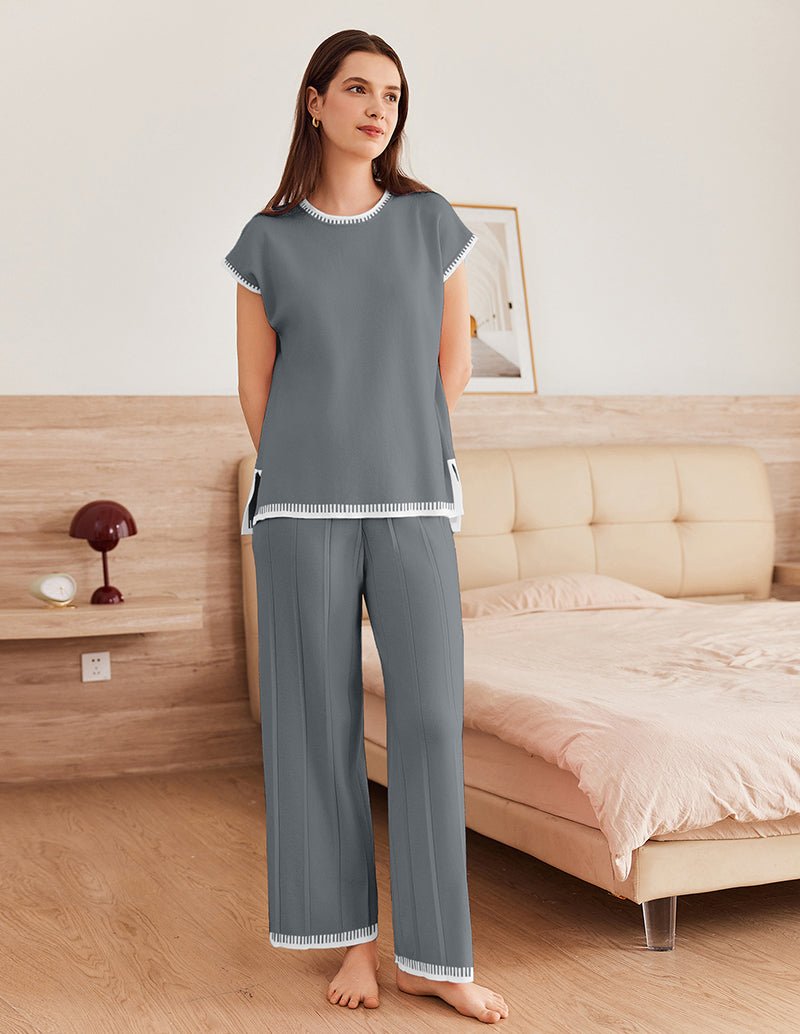
For sleepers who run warm, a waffle-knit set is a practical middle path. The open structure of the knit traps warm air without sealing it against the skin, so you get a little insulation without the sauna effect. The Ekouaer Waffle Knit Pajama Set is built in that structure, with a relaxed cut that does not twist around the waist when you turn over — a small thing that matters a great deal at 3 a.m., when every seam becomes noticeable.
For sleepers whose problem is the other direction — waking cold, or waking because the sheets have gone from warm to chilly — a brushed fabric does more work. Brushed milk silk, the material in the Ekouaer classic button-down pajama set, is finished so the surface feels soft rather than slick, which means it does not conduct heat away from the skin the way a cool, smooth satin does on contact. That is why it tends to be the more comfortable choice for the second half of the night, when core temperature is at its lowest and a chill is more likely to finish what a light-sleep boundary started.
And for the genuinely cold sleeper — the person who wakes at 4 a.m. with icy feet and cannot get back under — a light thermal layer is the honest answer, provided it is breathable enough not to overheat you in the first half of the night. The Ekouaer fleece-lined thermal set exists for that narrow band of the night. The general principle: dress for the coldest hour, not for bedtime. If you get into bed warm and wake cold at 4 a.m., the layer you chose at 10 p.m. was calibrated for the wrong moment.
The Part That Isn't Physical
By the third or fourth night of the same pattern, a second problem has usually formed on top of the first one: anticipation.
You start going to bed wondering whether it will happen. You wake at 3 a.m. and immediately check whether you feel rested, which is its own kind of monitoring. When you wake up at 3am every night, the brain — which is very good at learning associations — starts treating the bedroom as a place where sleep is attempted and often fails.
The countermeasure is to stop treating the wake-up as an emergency. A brief awakening is normal; a brief awakening that you greet with dread is what stretches into an hour. Keep the room dim, keep your response boring, and give yourself a script that does not involve evaluation: "This is a light-sleep boundary. It happens. I will get up if I am still awake in twenty minutes."
If the waking is consistently tied to a racing mind — the conversation you did not finish, the email you have not sent, the number you have not checked — the useful intervention happens earlier in the evening, not at 3 a.m. A short worry list, written down an hour or two before bed, gives the thought somewhere to go that is not your pillow.
Why Do I Keep Waking Up at 3 A.M.? Look at Your Day First
Most of what determines whether you wake at 3 a.m. was decided between lunch and bedtime.
Caffeine has a long tail. Its half-life means an afternoon coffee can still be measurably active at 3 a.m., and for slow metabolizers the effect is larger than they expect. If you are waking in the small hours, moving your last caffeine earlier by several hours is a cheap experiment with a fast answer.
Alcohol is the most common self-inflicted cause of exactly this pattern. It shortens the time it takes to fall asleep, then fragments the second half of the night as it is metabolized — which is why the classic description is "I fell asleep fine and woke at 3 and could not get back."
A heavy, late, carbohydrate-forward dinner can produce a blood-sugar dip in the early hours that arrives with a small adrenaline surge; a very light dinner can do something similar. The middle path — a normal meal, finished a few hours before bed, with some protein — is unglamorous and usually sufficient.
Light is the other lever. Bright light in the evening delays melatonin and pushes your internal clock later, which shifts the whole night and changes where the fragile hours land. Morning light does the reverse. Ten to twenty minutes outdoors shortly after waking is more effective than most supplements and considerably cheaper.
Waking Up at 3 A.M. Every Night: When to Talk to a Doctor
Waking at 3 a.m. is common, normal in moderation, and usually improvable with the boring items above. It is also sometimes a symptom, and the distinction is worth taking seriously without panicking.
Bring it to a clinician if the pattern happens most nights, if you cannot get back to sleep and daytime functioning is suffering, or if there are signs that breathing is involved — loud snoring, gasping, a dry mouth or headache in the morning, or a partner who has noticed pauses in your breathing. Those point toward sleep apnea, which is common, frequently undiagnosed and treatable, and which no amount of pajama selection will fix.
Persistent insomnia that has become a cycle of dread and broken nights is typically treated with cognitive behavioral therapy for insomnia, or CBT-I, which is recommended as a first-line approach for chronic insomnia in adults and is now widely available in digital formats. It is not a relaxation trick; it is a structured behavioral program, and it is the intervention with the strongest evidence behind it for exactly this problem.
What is not useful is diagnosing yourself from a list of causes. The lists are long — thyroid, reflux, medication side effects, perimenopause, restless legs, anxiety, blood sugar — and most of them cannot be distinguished from the inside. If the pattern persists for more than a few weeks, the efficient move is a conversation, not more research.
Comfort as a Standard, Not a Compromise

There is a version of this advice that treats comfort as a soft extra — something you get to once the serious sleep hygiene is handled. That is backwards. Comfort is the condition that makes the rest of it possible: a body that is not too warm, not damp, not twisted in a seam, and not cold at 4 a.m. is a body that can stay asleep through the fragile hours instead of being pulled out of them.
That is the standard Ekouaer builds to. Fabrics are OEKO-TEX Standard 100 certified — independently tested for harmful substances against the requirements for skin-contact textiles — and the fit is cut for the way people actually sleep: turning over, sitting up, getting out of bed in the dark. None of that is a treatment for insomnia. It is simply the layer you can control on a night when the rest of the night is doing what it does.
FAQ
Q: Why do I wake up at exactly 3 a.m. and not at another time?
A: The consistency comes from the structure of your night rather than from the clock. Deep sleep is concentrated in the first half, so by the early hours you are in lighter sleep, closer to the surface, and your core temperature is near its lowest while cortisol is beginning to rise. A normal brief awakening is far more likely to "stick" in that window — which is why the hour feels fixed.
Q: How long should I stay in bed before getting up?
A: Roughly twenty minutes. If you are still awake and increasingly frustrated, get up, keep the lights dim, and do something quiet and dull until you feel sleepy rather than obligated. Staying in bed and fighting it teaches your brain that bed is a place for being awake.
Q: Is waking at 3 a.m. a sign of something serious?
A: Usually not on its own. Brief awakenings are a normal feature of sleep. It is worth a medical conversation if it happens most nights, if you cannot return to sleep and your days are suffering, or if there is snoring, gasping, or a dry mouth in the morning — those can point to sleep apnea, which needs proper assessment.
Q: Does the November clock change actually affect sleep?
A: Yes, for most people temporarily. Your circadian rhythm is set by light and routine, not by the clock on the wall, so shifting the social clock by an hour leaves the internal one out of step for several days. People who already wake in the early hours often notice the pattern sharpening for a week or two. A fixed wake time and morning light shorten the adjustment.
Q: What should I wear to bed if I keep waking up hot?
A: A breathable, moisture-moving fabric in a relaxed cut, and bedding you can adjust in layers. Waffle knits and brushed cotton blends work well because they hold a little warmth without sealing it against the skin. Avoid heavy, occlusive fabrics and anything that twists at the waist when you turn over — the goal is one less thing to wake up for.
Q: Is it better to stay in bed and rest, or get up?
A: If you are calm, stay. Resting quietly in a dark room is not wasted time, and you may drift back. If you are frustrated or your mind is racing, get up briefly — the point is to break the association between bed and wakeful frustration, not to punish yourself for being awake.
Related Reading
-
Moisture-Wicking Pajamas: The Fabric Feature That Keeps Hot Sleepers Cool
-
Best Cooling Pajamas for Hot Flashes and Night Sweats (2026)
-
Waffle Knit vs Satin Pajamas: Which Fabric Wins for Fall 2026
-
How to Choose the Perfect Pajamas: A Fabric, Fit & Season Buying Guide
About Ekouaer
Ekouaer is a sleepwear and loungewear brand founded in 2015, built around functional design and fabric safety. Its fabrics carry OEKO-TEX Standard 100 certification, independently tested against the requirements for skin-contact textiles, and its ranges cover pajama sets, nightgowns, robes and loungewear for everyday wear at home.